


Getreidegasse
Salty-sweet debt.
Ten brittle rings, one on each outstretched finger, that was the currency between Aunt Feichtner and me. She was the boss of the legendary Viennese bakery at Getreidegasse 11, which everyone who has the grace of early birth still raves about today. (The bakery closed in 2003.) I was a cheeky elementary school student and the beneficiary of a debt to my grandmother that Ms. Feichtner had not paid off since the war and gave her a guilty conscience sufficient to meet my demands. My grandmother had long ago mentally written off the sack of salt that changed hands during the war without payment, but Aunt Feichtner had made me the sole beneficiary of her sweet debt repayment – with my utmost consent.

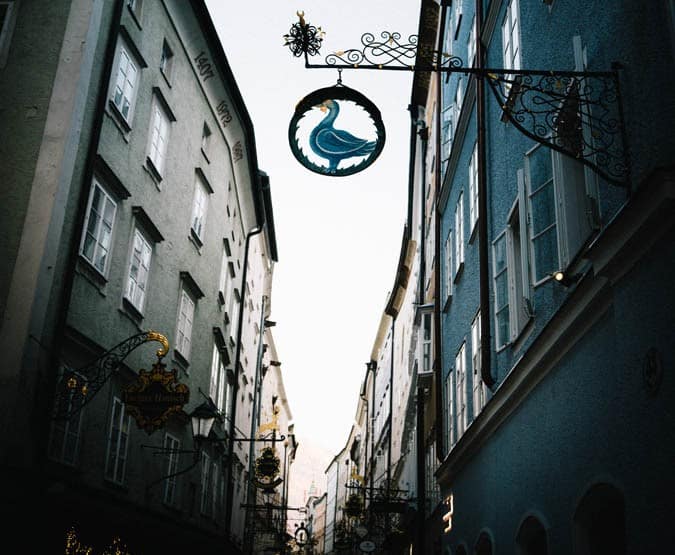
Historians associate the Getreidegasse with grandeur of a different kind: it is the street of mayors and city councilors, of pack traders and trading houses, of princely nurses and judges, of tradesmen and minters. It reflects the prosperity and splendor of a small principality. Almost all families steeped in history had their headquarters here. Court musicians such as Franz Heinrich Biber and Leopold Mozart were only subtenants here.
Tragasse”: This is what this main traffic artery was called in ancient times, and was the only thoroughfare in the city until the 17th century. It was first mentioned in a document in 1150. The name is derived from “traben” and “trabig” (= hastily). After all, this narrow street had to handle all the traffic between the city gates. Marchers, riders, carters and herds of cattle that were driven to the market in front of the residence, business people of all kinds: whoever had business in the city had to go through here.
I imagine that there were also such bad fellows like me who collected the debts of the past with persistence and without mercy.
Andreas Gfrerer
Impressions


